Introduction
Anthropic wants to list on Nasdaq at roughly $2 trillion, according to the FT, which would make it the largest IPO ever (Fortune 2026a). Eighteen months ago the same company raised money at $61.5 billion (Lightspeed Venture Partners 2025). Revenue has grown fast in that time (fair’s fair, it has grown absurdly fast), but a 32x markup in a year and a half needs more than fast growth. It needs someone at the end of the line to pay for it.
So who is that? Follow the money for long enough and the answer is you. More precisely, it’s your pension fund, your index fund, and the university endowment your alma mater keeps emailing you about. The money goes round a loop between the labs, the clouds and Nvidia, it gets booked as revenue at every stop, and the only cash that enters the loop from outside comes from people who never asked to be in it. For a $2 trillion price to make any sense, Anthropic has to end up earning roughly what Microsoft earns.
The recycling engine
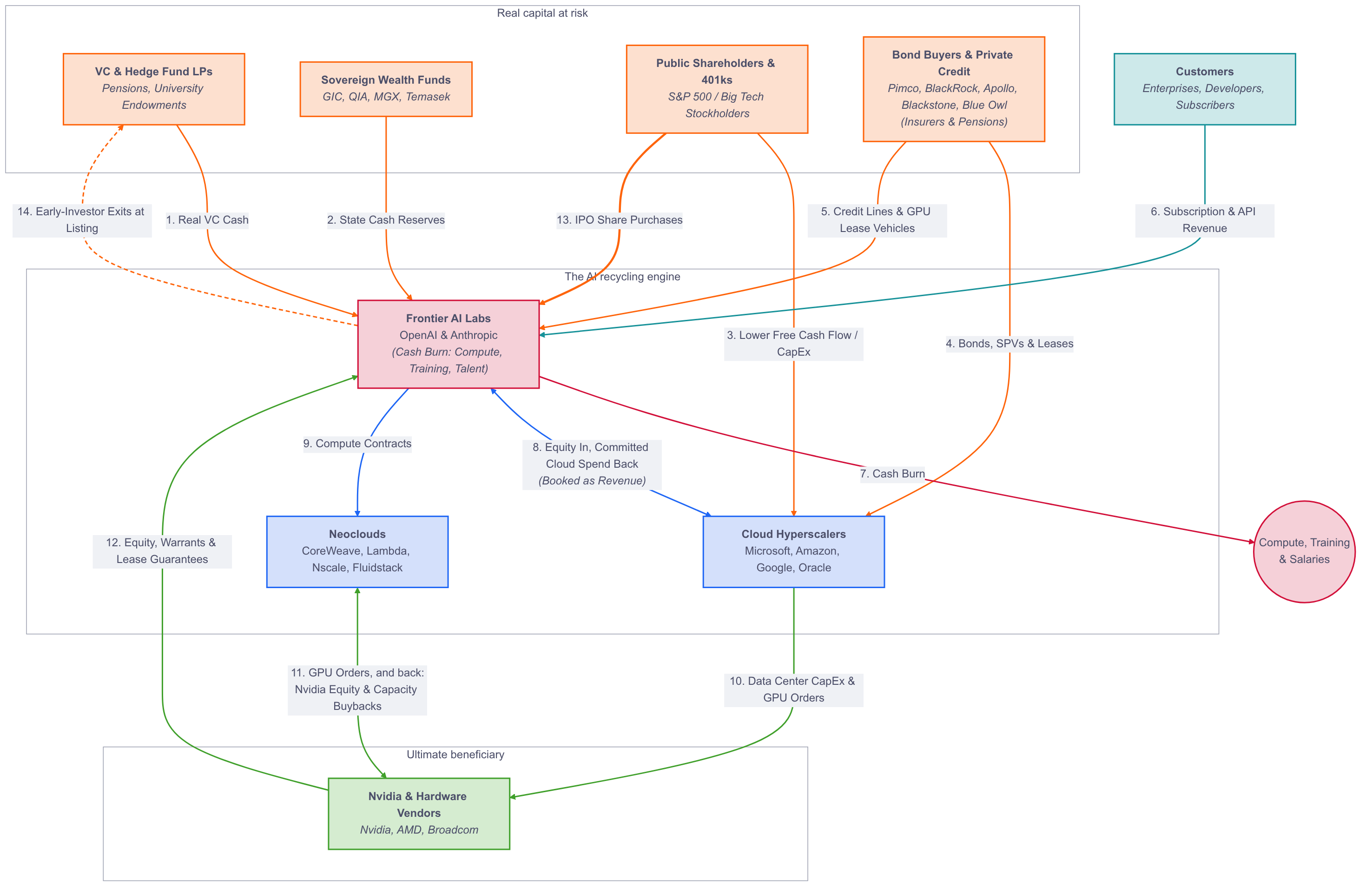
Arrow 8 is the circle, and it’s where it gets silly. Amazon has put $8 billion into Anthropic, added $5 billion in April, and promised up to $20 billion more tied to milestones. In the same announcement Anthropic committed more than $100 billion to AWS over ten years (Amazon 2026). Google put in $3 billion for about 14 percent, then offered up to $40 billion more, and Google is also the company selling Anthropic its TPUs (TechCrunch 2026b; Anthropic 2026a). Microsoft and Nvidia pledged up to $15 billion between them in November 2025, and Anthropic committed $30 billion to Azure on the same day (Microsoft 2025). AMD invests up to $5 billion and sells Anthropic up to two gigawatts of MI450 GPUs (AMD 2026). Akamai signed an $11.6 billion compute deal and gave Anthropic a warrant for up to 5 percent of Akamai as a thank you (Akamai Technologies 2026).
Ok so think about what that does to the books. Amazon hands Anthropic a dollar. Anthropic hands the dollar back to AWS for compute. AWS books it as cloud revenue, and Amazon’s stake in Anthropic gets marked up at the next round, which was priced partly on how much compute Anthropic has locked in. The same dollar shows up as an investment, a cost, a revenue line and a valuation gain. Nobody in that sentence broke a law. It’s also a pretty strange way to measure demand.
Arrows 11 and 12 are Nvidia’s contribution. Nvidia signed a letter of intent to put “up to $100 billion” into OpenAI while OpenAI bought Nvidia systems (NVIDIA 2025). That letter never became a contract. It turned into a $30 billion equity cheque in OpenAI’s February round (TechCrunch 2026c). Nvidia’s latest 10-Q shows it guaranteeing up to $105 billion of 20-year data-center leases for an OpenAI affiliate in Ohio, kicking in if the tenant defaults, on a campus that runs Nvidia hardware exclusively. The same filing lists $99 billion of equity investments, another $25 billion committed “in AI model makers, infrastructure financiers”, and $36 billion of commitments to buy back cloud capacity from the AI clouds it sells chips to (NVIDIA Corporation 2026). On the Anthropic side, Nvidia backs Lambda, supplies Lambda’s GPUs and holds the lease on the site where Lambda will run Anthropic’s $35 billion contract (Bloomberg 2026c).
AMD did the OpenAI version with a straight face. OpenAI gets a warrant for 160 million AMD shares at one cent each, vesting as OpenAI buys AMD chips and as AMD’s share price climbs (Advanced Micro Devices 2025). Buy our GPUs and we’ll pay you in our stock, which goes up when you buy our GPUs.
Where the money comes from
Everything inside the loop is a transfer. Somebody has to put real cash in at the top, and there are four somebodies.
The first is venture money. US venture funding hit a record $267 billion in the first quarter of 2026, 89 percent of it went to AI, and 73 percent of the total went to five companies: OpenAI, Anthropic, xAI, Waymo and Databricks (SiliconANGLE 2026). That money belongs to the funds’ limited partners, which are pension funds, insurers, endowments and foundations. When a VC fund writes a billion-dollar cheque into a pre-IPO round, it’s writing it with a teacher’s retirement savings.
The second is sovereign money. GIC (Singapore) took part in Anthropic’s Series F, co-led the Series G and co-led the Series H. Qatar’s QIA joined the Series F, Abu Dhabi’s MGX co-led the Series G, and Temasek came in on the Series H (GIC 2025; Crunchbase News 2026; Anthropic 2026b). That’s state reserves, the money a country saves for when the oil runs out or the population gets old.
The third, and the biggest, is you as a shareholder. Microsoft, Amazon, Alphabet and Meta guided to roughly $725 billion of capital expenditure for 2026, up from about $410 billion in 2025 (Bloomberg 2026d; Sherwood News 2026; The Wealth Advisor 2026). FactSet expects free cash flow near zero or negative for everyone in that group except Alphabet and Microsoft, and counts another $820 billion of lease commitments sitting off the balance sheets (FactSet 2026). The cash that used to come back to shareholders as buybacks and dividends is now going into data centers.
The fourth is borrowed money, because when the cash runs out they borrow. Amazon, Alphabet, Meta and Oracle had issued about $194 billion of bonds by late July, against $108 billion in the whole of 2025. Order books that were five times covered in February were under two times covered by July (Fortune 2026b). Meta’s Hyperion data center sits in a $27 billion special purpose vehicle, 80 percent owned by Blue Owl, and Pimco bought about $18 billion of the bonds (Global Data Center Hub 2025). Anthropic’s TPUs get the same treatment: an Apollo and Blackstone vehicle of about $35 billion buys Google chips and leases them to Anthropic, with Broadcom guaranteeing what the chips will be worth at the end (Axios 2026). Pimco and Apollo manage money for, you guessed it, pensions and insurers.
SoftBank deserves its own paragraph. To fund its OpenAI commitments it sold its entire Nvidia stake (CNBC 2025), took a $40 billion unsecured bridge loan (Bloomberg 2026f), took a $10 billion margin loan secured on its OpenAI shares (Bloomberg 2026e), and on 23 September sold $11.1 billion of junk bonds, the largest high-yield corporate bond issue ever, to pay the next $10 billion tranche (Reuters via US News 2026).
Finally there’s the index. The ten largest stocks are now almost 40 percent of the S&P 500, up from 17 percent in 2015 (Carlson 2026). If you own a plain index fund you own the loop already, whether you wanted to or not. An Anthropic listing at $2 trillion would add one more very large member.
Who gains
Nvidia gains first and most. In the quarter to 26 July it booked $96.2 billion of revenue and $59.7 billion of net income, a 62 percent net margin. Three direct customers made up 44 percent of first-half revenue (NVIDIA Corporation 2026). Nvidia sells the shovels, lends money to the people buying shovels, and guarantees the leases on the sheds the shovels are stored in. Its own 10-Q says that the AI clouds it supports “lack the ability to secure long-term infrastructure contracts and investment-grade financing” (NVIDIA Corporation 2026).
The hyperscalers gain in two places. Lab spending on their clouds shows up as revenue growth, which is the number their share price trades on, and their equity stakes in the labs get marked up at every round. The first gain is real cash from outside investors passing through the lab. The second gain is on paper.
The early investors gain the most per dollar. Lightspeed led the Series E at $61.5 billion in March 2025 (Lightspeed Venture Partners 2025). At $2 trillion that’s a 32x markup in eighteen months. An IPO is the moment where that paper gain becomes cash, and the cash has to come from whoever buys at the listing. Goldman, JPMorgan and Morgan Stanley gain too. They’re lined up to underwrite the IPO and they already lead Anthropic’s $15 billion credit facility (Bloomberg 2026a).
Founders and early employees gain, and good for them, they built something people use. My problem is with the structure, where the private money that took the risk early gets to sell at a price set by a circular deal flow to the public money that arrives last.
What $2 trillion has to earn
Ok so let’s do the maths. A company is worth what it will pay its owners over its life. A mature, profitable software company trades at something like 20 to 30 times its earnings. So to be worth $2 trillion, Anthropic needs annual profits of about $2 trillion divided by that multiple, and the revenue it needs depends on what share of revenue it keeps as profit.
V = 2000  # valuation, $B
for pe in (20, 25, 30):
print(pe, [round(V / (pe * m)) for m in (0.15, 0.20, 0.30, 0.39)])| Price/earnings | 15% net margin | 20% | 30% | 39% (Microsoft) |
|---|---|---|---|---|
| 20x | $667B | $500B | $333B | $256B |
| 25x | $533B | $400B | $267B | $205B |
| 30x | $444B | $333B | $222B | $171B |
For reference, Microsoft made $332 billion of revenue in its 2026 fiscal year and $129 billion of net income after stripping out its gains on OpenAI, a 39 percent net margin (Microsoft 2026). Microsoft has had fifty years, an operating system monopoly and Office to get there. Even with Microsoft’s margin and a generous multiple, Anthropic needs $170 to $260 billion of revenue a year. With a margin that fits a business whose main cost is renting GPUs (15 to 20 percent), it needs $330 to $670 billion. And that only justifies today’s price. A buyer at $2 trillion who wants 10 percent a year for five years needs those numbers 61 percent higher by year five.
Where is Anthropic today? The run-rate passed $65 billion at the end of July, according to investor documents seen by Bloomberg (Bloomberg 2026b), and investors expect $100 to $120 billion by year end (Fortune 2026a). That’s impressive growth. Against the year-end figure the table is still 1.5 to 7 times away, and against today’s run-rate it’s 3 to 10 times.
Then there’s profit, and there’s no audited evidence that Anthropic makes any. The WSJ reported that Anthropic projected $559 million of adjusted operating profit for Q2 2026 on $10.9 billion of revenue, about 5 percent. That figure includes training but leaves out stock-based compensation, it’s unaudited, it covers a single quarter, and Anthropic told investors it may not stay profitable for the full year because compute and training spend is going up (Wall Street Journal via Yahoo Finance 2026). Ed Zitron points out that the quarter also includes the months when the SpaceX compute contract ran at a reduced ramp-up fee, before the full $1.25 billion a month applies (Zitron 2026; TechCrunch 2026a). The “above 80 percent gross margin” that went round in September is a different number, and it’s measured before the revenue Anthropic shares with its cloud partners and before training costs (Dealroom 2026). Early this year The Information reported that Anthropic had cut its 2025 gross margin forecast to about 40 percent, because inference on Google and AWS cost 23 percent more than planned (The Information via Investing.com 2026b). The same outlet reported that Anthropic doesn’t expect to be cash-flow positive before 2028 (The Information 2026). The first full-year numbers came from Anthropic’s draft prospectus, which Reuters saw in late September. Revenue in 2025 was about $4.6 billion, the operating loss was more than $8 billion, and the net loss was $42 billion, of which about $34 billion is a non-cash charge on financing that may convert into shares. The draft has no 2026 figures, and the public S-1 is still not on EDGAR (Reuters via CNBC 2026).
And then there are the obligations, which is where I’d look if I were asked to buy. Anthropic’s revolving credit facility is $15 billion (Bloomberg 2026a), which is small. The real debt is the compute. By The Information’s count Anthropic had signed about $517 billion of compute deals, 14.8 gigawatts, in the eleven months to August (24/7 Wall St. 2026). The draft prospectus puts the total at about $518 billion over roughly ten years, and about 80 percent of it can’t be cancelled. Broadcom accounts for $161 billion, Google $111 billion, Amazon $110 billion and Microsoft $31 billion (Reuters via CNBC 2026; CloudComputing News 2026). That’s $113 of committed compute for every dollar Anthropic earned in 2025. Spread over ten years it’s $52 billion a year, against a current run-rate of $65 billion. So the committed compute bill alone is 80 percent of everything Anthropic currently sells, before a single salary is paid.
That’s fine if revenue keeps compounding. Every one of those contracts is a bet that it will. For comparison, OpenAI’s own plan, as reported by the FT, has it burning about $280 billion of free cash flow from 2026 to 2030, while revenue grows from $36 billion to $350 billion (GV Wire / Reuters 2026).
Why I wouldn’t buy it
The price assumes Anthropic becomes Microsoft. It might. But Microsoft’s margin comes from software that costs almost nothing to copy. Anthropic’s product costs real electricity every time someone uses it, and it sells into a market where the price keeps falling. Claude Fable 5.1 shipped in September about 25 percent cheaper than Fable 5 (Green 2026b), which is great for me as a user and bad for a $2 trillion multiple.
The moat is thin. On the Artificial Analysis index the best open-weights model, Xiaomi’s MiMo-V2.6-Pro, sits 11.3 points behind Claude Opus 5.5. It’s MIT licensed, and anyone can download it, run it and fine-tune it (Green 2026a). Eleven points is a real gap today. It’s also a gap that anyone paying Anthropic’s prices has a strong incentive to close. When my own team picked a coding assistant in September we ended up self-hosting Qwen3.8-27B on our own server. Anthropic’s other defence is regulatory, and I’ve written about how neatly the doom talk lines up with the funding calendar (Green 2026b).
You get no say. Anthropic is a public benefit corporation, so its directors are allowed to weigh the mission against your returns. Since April the board majority has been appointed by the Long-Term Benefit Trust, whose trustees hold no financial stake (Anthropic 2023). And the IPO structure proposed in September would give the seven co-founders 50.1 percent of the vote on most matters through supervoting shares (The Information via Investing.com 2026a). You’d be paying $2 trillion for a company where you can’t elect a board majority and the directors are allowed to put you second.
The hardware depreciates. Michael Burry’s argument is that the hyperscalers are stretching the useful life of their GPUs on paper, which understates depreciation by about $176 billion between 2026 and 2028 (Burry 2025). If a GPU is really worth something for three years and the lease runs for six, then the second half of every one of those compute contracts is paying for old chips.
And you’re the exit. Every earlier buyer in the chart above either gets paid in revenue on the way round or gets to sell at the listing. The public buyer at the IPO is the first participant whose only way out is someone else paying more.
Conclusion
The AI loop is a real business wrapped in a financing structure that makes it look bigger than it is. The models are good and the revenue is real. The valuation assumes revenue several times larger, at margins nobody in the business has shown yet, while the same few companies pass the same dollars round in a circle and count them at every stop. The cash that keeps the circle spinning comes from pension funds, sovereign reserves and index investors, and a $2 trillion IPO sells the next and largest piece to them. So before your pension fund buys in at the listing, who’s going to pay them more?