Introduction
A few months ago I wrote that Europe’s AI sovereignty problem is not regulation, it is labs. I still think that is right, and wanted to fold it out a bit more.
Most of the AI we actually run in Europe today rests on two pillars. One is the closed frontier from the United States: OpenAI, Anthropic, Google. The other is the open-weights frontier from China: Qwen, GLM, DeepSeek, the whole Zhipu (Z.ai) and Alibaba and DeepSeek stack. We have gotten very comfortable leaning on both of them. We build on top. We fine-tune. We serve. We write wrappers and agents and evals. And we tell ourselves we have options, because if one pillar gets weird we can hop to the other.
Here is what I am worried about. Both pillars can be pulled out from under us, for different reasons, on different timelines, and pretty much nobody in European policy is planning for the world where that happens at the same time.
I am going to walk through why each one is shakier than it looks, and then why the combination is the part that should keep us up at night.
Pillar one: the closed frontier can be turned off
This is the one people sort of know about but tend to file away as a hypothetical. It is not hypothetical (Garcia 2026).
When your product calls an API hosted by a US-headquartered lab, you are depending on three things that can all change without your input: the lab’s terms of service, the lab’s pricing, and the US government’s export control regime. Any one of those three can cut you off. The API is a service you rent, and the landlord can change the lease.
We already saw what this looks like. In early 2026 Anthropic tried to set its own policy on military AI use, refusing to bend its safeguards on autonomous weapons and mass surveillance, and the Trump administration ordered federal agencies to stop using Claude and designated the company a supply-chain risk (Associated Press 2026). Anthropic set out its own position publicly (Anthropic 2026b), and the reaction from the US government was so swift and so public that no rational company will try that again. The lesson every frontier lab took from that episode is not subtle. If Washington decides access is a strategic lever, access becomes a strategic lever, and the company at the other end of your API call will comply before you finish reading the press release.
The US has also been building out export-control machinery for advanced models. The Biden-era “AI Diffusion Framework” of January 2025 tiered countries by how much compute and model access they could get, and most EU allies landed in the top tier with near-frictionless access, not the middle. That sounds fine for Europe until you notice that the Trump administration then rescinded the whole rule and is drafting a replacement (U.S. Bureau of Industry and Security 2025). Even a top-tier arrangement is “subject to change” on someone else’s decision. Permission, even generous permission, is a dependency with a nicer name.
So the closed frontier is a pillar we are allowed to lean on as long as nobody in Washington decides we shouldn’t. That is a strange foundation to build a continent’s cognitive infrastructure on.
Pillar two: the open-weights frontier is not a guarantee
This is the part I think even the sovereignty people underestimate. We have gotten used to treating the Chinese open-weights releases as a kind of safety net. Alibaba drops Qwen, a strong model with open weights. Zhipu drops GLM. DeepSeek drops something that punches above its weight. We download the weights, we host them, we feel good about having a fallback.
But “open weights so far” is not the same as “open weights forever.” These are not charities. They are labs competing in a frontier race, and they release weights because it happens to serve their strategy right now, not because of a constitutional commitment to openness. The moment releasing the frontier weights stops serving them, the releases stop. There is no contract. There is no license that forces the next version to exist.
Think about what we are actually assuming. We are assuming Qwen 3.7 (Alibaba Cloud 2026) will be open-sourced the way the earlier Qwen releases were. Maybe some of it will. But there is no guarantee, and the incentives are not obviously pointing that way. Once a lab is genuinely competitive at the frontier, the strategic value of giving your best weights away for free drops a lot. You start hearing about “safety” and “responsible release” and “phased rollouts” and suddenly the open-weights cadence gets a lot more selective. We have seen this movie before. It is exactly what happened with the US labs. I will come back to this with concrete numbers, because as I was writing this post I found that part of it has already happened.
Same story with GLM. Zhipu has been generous with GLM-4 up to GLM-5.2 weights. There is no guarantee GLM-5.3 is. And even if the labs want to keep releasing, they are operating under their own government’s rules. China has been building its own export-control and dual-use regime. If Beijing decides frontier weights are a strategic asset, the releases stop the same way they would stop from Washington’s side. We are trusting that two governments we have no say in will both continue to allow their best labs to hand us their best models for free. That is a lot of trust. As of July 2026 that trust is actively being tested: Beijing is consulting on exactly this kind of restriction, and I come back to it with the Reuters reporting below.
There is also the quieter risk that the open-weights releases just get worse relative to the frontier. Maybe Qwen keeps publishing weights, but only for the smaller, older, or distilled variants, and the actual frontier model stays behind an API. That is a softer version of the same problem and in some ways more dangerous because it is easier to miss. You are still “using open source AI,” you just happen to be a generation behind the frontier and falling further behind every release cycle.
The gap, in numbers
It helps to put a concrete comparison on the table, because “close to the frontier” might be a bit loosy poosy and I want you to see what it actually means right now by inspecting Table 1.
Take GLM-5.2 (Z.ai 2026), Zhipu’s current open-weight flagship (MIT licensed, shipped June 2026, roughly a million-token context), against Claude Opus 4.8, Anthropic’s current closed frontier in the Opus series. On the six benchmarks both report, Claude leads on all six:
| Benchmark | GLM-5.2 | Claude Opus 4.8 |
|---|---|---|
| FrontierSWE | 74.0% | 75.0% |
| GPQA | 91.2% | 93.6% |
| Humanity’s Last Exam | 54.7% | 57.9% |
| MCP Atlas | 76.8% | 82.2% |
| SWE-Bench Pro | 62.1% | 69.2% |
| Toolathlon | 48.2% | 59.9% |
Two things to notice. First, on the coding-and-tool-use end of the frontier the gap is real: SWE-Bench Pro is seven points, Toolathlon is nearly twelve. That is the ceiling I will come back to when I talk about fine-tuning. Second, on the knowledge-and-reasoning end the gap is small, two to three points on GPQA and Humanity’s Last Exam, and on FrontierSWE it is a single point. The open-weights frontier is genuinely close.
Now look at what you trade off to get that openness. GLM-5.2 is MIT licensed. You can download it, host it, fine-tune it, run it inside your own perimeter, and it costs about $0.95 per million input tokens against Claude’s $5.00, and $3.00 versus $25.00 per million output. That is roughly 6.8x cheaper on a blended basis. Claude is multimodal and slightly ahead on raw capability. GLM is text-only, MIT-licensed, a touch behind, and yours to run.
But of course we’re not dealing with the elephant in the room. I benchmarked GLM-5.2 against Claude Opus 4.8, which is a frontier model but not the newest one. Stack the actual current frontier, Anthropic’s Claude Fable 5 (Anthropic 2026a) and OpenAI’s GPT-5.5 Pro (OpenAI 2026), against both open-pillar flagships and the picture changes:
| Benchmark | Claude Fable 5 | GPT-5.5 Pro | GLM-5.2 | Qwen3.7 Max |
|---|---|---|---|---|
| Humanity’s Last Exam | 64.5% | 57.2% | 54.7% | 41.4% |
| SWE-Bench Pro | 80.0% | - | 62.1% | 60.6% |
| SWE-Bench Verified | 95.0% | - | - | 80.4% |
| FrontierSWE | 90.0% | - | 74.0% | - |
| Terminal-Bench 2.1 | 84.3% | - | 82.7% | - |
| LiveBench | 78.3% | - | - | 74.3% |
| Finance Agent v2 | 56.3% | - | - | 48.4% |
| GDPval-AA | 60.5% | - | - | 43.6% |
A few things to read off this. On Humanity’s Last Exam, the one benchmark all four report, Claude Fable 5 (64.5) leads GPT-5.5 Pro (57.2), GLM-5.2 (54.7), and Qwen3.7 Max (41.4). GPT-5.5 Pro and GLM-5.2 are nearly tied on that one, so the real separation is Fable 5 a tier above and Qwen3.7 Max a tier below. On the agentic and coding benchmarks that production work actually runs on, the gaps widen fast: FrontierSWE is sixteen points between Fable 5 and GLM-5.2, SWE-Bench Pro is eighteen. And note GPT-5.5 Pro’s pricing, $30/$180 per million tokens, roughly three times Fable 5 and thirty to sixty times GLM-5.2’s self-hosted inference, for the privilege of sitting a few points behind Fable 5 on the one benchmark it reports. The closed frontier is a moving target, and an expensive one. The open-weights pillar is genuinely close to a frontier model, and a clear step behind the actual frontier model, and the frontier moves every quarter. The gap you close by waiting for the next open release can reopen in the same quarter when the closed side ships again.
This is exactly why the open-weights pillar is so comfortable to lean on, and exactly why its loss would hurt so much. The deal today is remarkably good: near-frontier capability, open weights, self-hostable, at a fraction of the closed price. The risk is that this deal is a strategy choice by Zhipu and a permission choice by Beijing, and either one can change without consulting us. The numbers above are a snapshot of a generous moment, and a snapshot is not a contract.
The hypothetical is already happening
I want to flag something, because the risk I have been describing is less hypothetical than I made it sound a few pages back. Look at the Qwen3.7 Max column in the table above. On the shared benchmarks it sits a clear tier behind Claude Fable 5, SWE-Bench Verified 80.4 versus 95.0, SWE-Bench Pro 60.6 versus 80.0, Humanity’s Last Exam 41.4 versus 64.5. That is the gap I expected.
The license field is the part that actually worried me. Qwen3.7 Max is listed as proprietary, same as Fable 5 and GPT-5.5 Pro. The frontier of the open-weights pillar’s flagship line is API-only. You cannot download it. You cannot host it. You cannot fine-tune the weights. It ships through Novita and Together, on someone else’s terms.
This is the softer version of the risk I described earlier, the one I said was more dangerous because it is easier to miss. Maybe smaller Qwen 3.7 variants still come out as open weights. But the frontier beam, the actual frontier-class model you would want as your safety net, is already behind an API for this generation. The pillar I called “open weights so far” just lost its frontier tier to “open weights for the smaller models, proprietary for the one that matters.” The hypothetical I was asking you to imagine is, for the Max tier, already the situation on the ground.
The scenario that nobody is planning for
Ok so individually each pillar is a known risk. The part I want to name out loud is the combination.
Suppose the US closed labs restrict access to their best models. This does not have to be dramatic. It can be a tier change, a terms-of-service update, a pricing tier that quietly prices European startups out of the frontier, a “not available in your region” line in a changelog. We have seen each of those individually already.
And suppose, on a different timeline, the Chinese open-weights labs stop releasing frontier weights. Qwen 3.7 stays behind an API. GLM-5.3 stays internal. Maybe DeepSeek keeps publishing but it is a model class behind. Just a quiet drift where the open-weights frontier stops being the frontier.
Now ask the uncomfortable question. In that world, what do European builders actually run?
We do have one real exception, and I will get to Mistral in a minute, because they matter and they change the picture. But strip out Mistral for a second and look at the rest of the European landscape. We have some good work on smaller models, some fine-tunes, some very solid application-layer and infrastructure work. What we mostly do not have is a broad bench of European labs producing frontier models that a European startup could build on without asking anyone’s permission. If both pillars get pulled and we are relying on the bench rather than the one French champion, the answer to “what do we run” is “something a generation behind, from someone else’s charity, on someone else’s terms.” That is a hope dressed up as a plan.
The reason this matters specifically for Europe is that we are the ones with no third pillar. The US has its own frontier labs. China has its own frontier labs. They will be fine on their terms. We are the ones who decided that regulation plus someone else’s weights plus someone else’s API was enough of a plan. It is not.
The permission choice is live too
The Qwen3.7 Max license is the lab side of this story. The permission side is moving too, and out in the open.
On 7 July 2026 Reuters reported, citing three sources, that Beijing is considering restricting overseas access to China’s most advanced AI models (Reuters 2026). The Chinese Ministry of Commerce led meetings in June with Alibaba, ByteDance, and Zhipu AI (Z.ai), the company behind GLM. The restrictions under discussion would cover both closed and open-weight models, and would likely apply to future models first. According to a summary of a May discussion among Chinese legal experts, published in an official journal of the Supreme People’s Court, the proposed structure is tiered: simple open-source models face only a simple filing requirement, advanced models go through security reviews, and top-tier models would either not be made publicly available or only be used domestically. The meetings also floated making the leakage or theft of AI technology a criminal offense under national security law, and new rules on who is allowed to finance domestic AI startups.
Read that tiered proposal carefully, because it is the “softer version” I described earlier, drafted as regulation. Smaller open models stay available. Frontier open models get pulled. This is exactly the drift I said was more dangerous because it is easier to miss, except it is now a policy consultation with a written tiered structure, reported by a serious news agency, involving the three companies whose models the open-weights pillar is built on.
And it is happening alongside its mirror image in Washington. In mid-June the US government ordered that foreign nationals not have access to Anthropic’s Fable 5 and Mythos 5, on national security grounds, which prompted Anthropic to disable the models globally; export controls on Fable were later lifted after new safeguards, while Mythos stayed restricted to trusted US organisations. Alibaba has reportedly banned its employees from using Anthropic’s Claude over surveillance concerns. Both capitals now treat frontier model access as a strategic lever. The two pillars we are leaning on are both being pulled, from both ends, by the governments that control them, in the same month.
But what about Mistral?
If you have been reading this and shouting “Mistral!” at your screen, good. It is the right reflex, and it is the one place where my “we have no pillar” framing needs a correction.
Mistral is the closest thing Europe has to its own frontier lab, and lately they have been doing the actual work. In December 2025 they shipped Mistral Large 3, a 675-billion-parameter open-weight frontier model with multimodal and multilingual capabilities (Mistral AI 2025), the kind of release that trades blows with Llama 3 and Qwen3-Omni rather than trailing them. You can download the weights. You can host them. You can fine-tune them. That is a European frontier-ish model you can run without asking Washington or Beijing for anything. They are also putting their money where the sovereignty argument is: $830 million in debt financing this spring to build a data center near Paris packed with 13,800 Nvidia chips (CNBC 2026). That is real European compute, on European soil, for a European lab. And Arthur Mensch, their CEO, spent last week telling anyone who would listen that closed models hand providers dangerous leverage over enterprises (Stan 2026), which is the same argument I am making here, said by someone who is actually building the alternative.
So when I say we need more frontier AI labs, I mean on top of what Mistral has already started. Mistral counts a lot. Mistral is proof that the third pillar can be built in Europe, by Europeans, at a level that matters. The question is whether one lab is enough for a continent.
It is not. A single champion, however good, is still a single point of failure. If you care about sovereignty you should care about redundancy, and right now the European frontier is roughly Mistral-shaped. Mistral is also playing a pragmatic game on openness: some releases are open-weight, some sit behind an API, and the mix shifts with their enterprise strategy. That is their call and a reasonable one, but it means the open-weight frontier you can actually download from Europe tracks their commercial decisions, and those decisions can shift the same way every other lab’s have. Sound familiar?
There is also a funding reality worth naming. Mistral has raised around $2.7 billion at a $13.7 billion valuation. That is a serious company by any normal measure. OpenAI has raised $57 billion at a $500 billion valuation. Anthropic has raised $45 billion at a $350 billion valuation. Mistral is competing in a race where the runners next to them have roughly twenty times the capital. They are punching remarkably above their weight, and the gap is still real, and it is exactly the gap that more European labs with serious runway would help close. The answer to “Mistral exists” is “good, now we need several of them, and we need to make sure they can actually spend what it takes to hold the frontier.”
The cleanest yardstick I have for “how far behind is Europe” is a public model leaderboard snapshot from 11 July 2026, fifty models ranked on a 0-100 overall score across eight capability categories. One source, one methodology, so the numbers are actually comparable across labs:
| Rank | Model | Overall | Source | $/M in/out |
|---|---|---|---|---|
| 1 | Claude Fable 5 | 91 | Proprietary, US | $10 / $50 |
| 2 | Claude Mythos 5 | 89 | Proprietary, US | $10 / $50 |
| 3 | Gemini 3.1 Pro | 88 | Proprietary, US | $2 / $12 |
| 5 | Claude Opus 4.8 | 85 | Proprietary, US | $5 / $25 |
| 8 | Qwen3.7 Max | 83 | Proprietary, China | - |
| 10 | GLM-5.2 | 81 | Open weight, China | $1.4 / $4.4 |
| 13 | GPT-5.5 | 78 | Proprietary, US | $5 / $30 |
| 14 | DeepSeek V4 Pro (Max) | 78 | Open weight, China | $1.74 / $3.48 |
| 17 | GLM-5 (Reasoning) | 77 | Open weight, China | $1 / $3.2 |
| 20 | Kimi K2.6 | 74 | Open weight, China | $0.95 / $4 |
| - | Mistral Large 3 (675B) | 47¹ | Open weight, France | - |
Read that table the way a builder reads it. The closed US frontier occupies the top, Fable 5 at 91, Mythos 5 at 89, Gemini 3.1 Pro at 88, Opus 4.8 at 85. The open-weight Chinese cluster sits a tier below but firmly in the conversation, GLM-5.2 at 81, DeepSeek V4 Pro at 78, GLM-5 Reasoning at 77, Kimi K2.6 at 74. Then there is Europe. Mistral Large 3, the thing we keep calling our champion, scores 47 on the same scale, below the top-fifty cutoff (rank 50 sits at 57). Roughly half the frontier, and behind every single open-weight Chinese model on the board. The frontier tops at 91, the open weights hold the 74-81 band, and Europe’s flagship is down at 47, off the ranked list entirely.
Break it down by category and the shape of the gap gets clearer. Same source, same scale:
| Model | Agentic | Coding | Knowledge | Reasoning | Source |
|---|---|---|---|---|---|
| Claude Fable 5 | 99.4 | 93.6 | 89.0 | - | Proprietary, US |
| Claude Opus 4.8 | 93.6 | 89.9 | 88.2 | - | Proprietary, US |
| Qwen3.7 Max | 75.6 | 88.0 | 79.1 | 78.7 | Proprietary, China |
| GLM-5.2 | 84.5 | 78.6 | 84.5 | - | Open weight, China |
| GPT-5.5 | 96.1 | 72.5 | 82.2 | 81.9 | Proprietary, US |
| Mistral Large 3 | 39.8 | 36.3 | 44.4 | 49.2 | Open weight, France |
On agentic work, the thing agents and coding workflows actually run on, Fable 5 is at 99.4 and GPT-5.5 at 96.1; the open-weight GLM-5.2 is at 84.5; Mistral is at 39.8. On coding, Fable 5 93.6, Opus 4.8 89.9, the proprietary Qwen3.7 Max 88.0, and Mistral 36.3. The frontier is in the 80s and 90s on the categories that ship production, the open weights (GLM-5.2, DeepSeek) are in the high 70s to 80s, and Europe’s champion is in the 30s and 40s. Same parameter scale as GLM-5.2, a quarter to half the score on the categories that matter.
Two things in that table deserve to be underlined, because they are not footnotes. First, Qwen3.7 Max sits at rank 8, overall 83, and it is marked Proprietary (Alibaba Cloud 2026). A second independent source now confirms what the earlier section flagged: the frontier tier of the open-weights pillar’s flagship line is API-only. You can buy it, you cannot download it. Second, GPT-5.5, OpenAI’s entry here, lands at 78, below GLM-5.2 (81, open weight) and Qwen3.7 Max (83, proprietary) on this overall. On a July 2026 overall the open weights, GLM-5.2 and DeepSeek V4 Pro, are neck and neck with OpenAI’s current model, which is exactly why losing them would gut European builders.
And this is at the same parameter scale: Mistral Large 3 is 675 billion parameters, the same scale as GLM-5.2. Same scale, and GLM-5.2 is rank 10 overall at 81 while Mistral sits at 47, off the ranked board. The gap lives in compute and refinement, which is the funding-and-runway gap from a minute ago. This is the concrete version of “Mistral counts, and Europe still needs more labs with more compute.” A 675-billion-parameter open-weight model you can run yourself is a real asset. A 675-billion-parameter open-weight model that scores 47 on the same scale where the frontier scores 91, with 39.8 on agentic where the frontier scores 99.4, is a real warning about how far the capital gap pushes you.
The speed gap, not just the level
The 47 is a level. The thing that should worry Europe more is the slope. How fast is Mistral actually climbing relative to the frontier? BenchLM scores every model on the same 0-100 composite, so I can put a 2024 model and a 2026 model on the same scale and read the speed off the difference.
In 2024 the major labs were all clustered in the high-30s to high-40s on this composite. Here is how each one got from its 2024 model to its 2026 model.
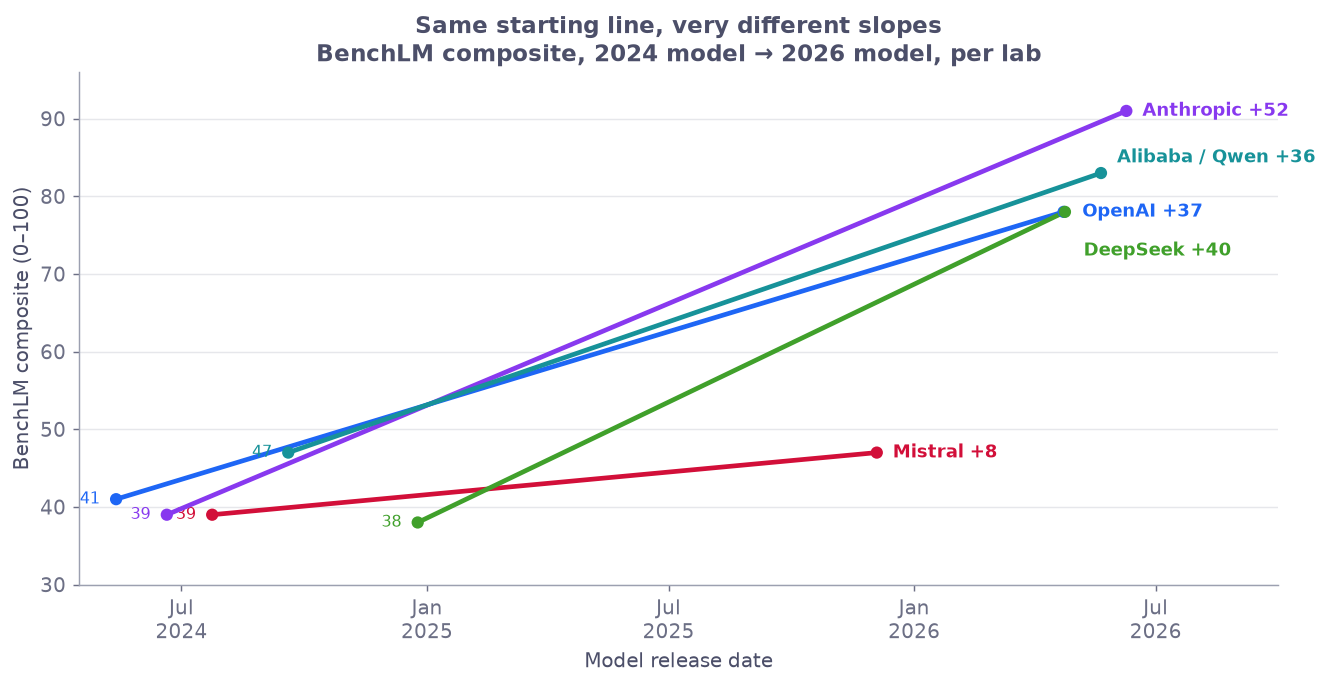
Read the Gain. Anthropic +52, DeepSeek +40, OpenAI +37, Alibaba +36, Mistral +8. Per month that is roughly DeepSeek 2.5, Anthropic 2.2, Alibaba 1.8, OpenAI 1.6, Mistral 0.5. DeepSeek’s open weights climb at the same speed as the US closed frontier. DeepSeek is the fastest of the five, slightly ahead of Anthropic. Alibaba’s frontier climbed to 83 too, but its frontier tier went proprietary: Qwen3.7 Max is API-only, with Qwen3.6 the open-weight line at 65 on this composite. The open-weights pillar’s frontier has partly closed even as the lab kept climbing. Mistral is the lone outlier, moving at about a fifth of the frontier’s pace. The level gap I showed earlier, 47 versus 91, is what you get when one lab compounds at a fifth of the others’ speed for two years. This is a velocity gap. Velocity gaps compound. This is one aggregator’s view, not a single controlled harness run identically on every model. Mistral’s BenchLM rows are Artificial-Analysis-sourced (independent), whereas some competitors’ composites lean partly on provider self-report. The numbers are also provided in Table 5.
| Lab | 2024 model | 2026 model | Gain |
|---|---|---|---|
| Mistral | Large 2: 39 (Jul 2024) | Large 3: 47 (Dec 2025) | +8 in ~16 months |
| Anthropic | 3.5 Sonnet: 39 (Jun 2024) | Fable 5: 91 (Jun 2026) | +52 in ~24 months |
| OpenAI | GPT-4o: 41 (May 2024) | GPT-5.5: 78 (Apr 2026) | +37 in ~23 months |
| DeepSeek (open weight) | V3: 38 (Dec 2024) | V4 Pro Max: 78 (Apr 2026) | +40 in ~16 months |
| Alibaba/Qwen (open → closed) | Qwen2.5-72B: 47 (Sep 2024) | Qwen3.7 Max: 83 (May 2026) | +36 in ~20 months |
The second thing this table buys us is that the open-weights pillar is a fast-moving target. DeepSeek V3, an open-weight model from December 2024, scored 38 on this composite, tied with Mistral Large 2 from six months earlier. About sixteen months later DeepSeek is at 78 and Mistral at 47. Same kind of window, DeepSeek climbed 40 points, Mistral 8. Or take Alibaba: Qwen2.5-72B, open weight, September 2024, scored 47, the level Mistral Large 3 would only reach more than a year later. DeepSeek’s open weights are improving at frontier speed (it sits at 78, level with GPT-5.5), and even Alibaba’s open-weight Qwen3.6 line reaches 65, well ahead of Mistral’s 47. The open weights the European piece is leaning on are moving fast, which is exactly why the prospect of losing them, to a Zhipu strategy choice, a Beijing permission choice, or a frontier tier simply going closed the way Qwen3.7 Max did, would gut European builders overnight.
And note what Mistral did not ship in those 16 months: a competitive reasoning model. The composite partly measures exactly that, because Humanity’s Last Exam, SciCode, and the Artificial Analysis suite (Artificial Analysis 2026) reward chain-of-thought, and the frontier and the Chinese open weights moved to reasoning models while Mistral’s flagship stayed a non-reasoning instruct model. The frontier and the open-pillar both changed the kind of model they ship, and Europe’s champion did not. That is the slope gap in concrete form.
This is the part that should scare the policy people most. Closing a level gap is a question of one good model. Closing a velocity gap is a question of sustained compute, sustained talent, and sustained runway, the things Europe has not funded at frontier scale. A continent moving at a fifth of the frontier’s speed falls further behind every quarter it waits, and the open weights it leans on are running at full frontier speed in someone else’s hands.
Why “we’ll just fine-tune” is not an answer
The thing I hear a lot, is “well, we will just fine-tune an open model and that will be good enough.” I like fine-tuning. I do it. But fine-tuning is not a substitute for having a frontier base model to fine-tune from. You can fine-tune a model that is already good. You cannot fine-tune your way from a small model to a frontier model. The capability ceiling is set by the base. If the best base you are allowed to touch is a generation behind, no amount of fine-tuning closes that gap. The GLM-5.2 versus Claude Opus 4.8 numbers above are the polite version of this: even a strong open-weight model sitting a few points behind the closed frontier is a ceiling you can nudge with fine-tuning but not break through. Drop the base another generation and you are not a few points behind, you are playing a different sport.
This is why the open-weights pillar matters more than people give it credit for, and why its potential loss is more dangerous than the closed-pillar loss. The closed pillar at least has a contractual surface. You pay, you get access, you get cut off, you know. The open-weights pillar is the one we treat as ambient infrastructure, and it is the one that can disappear quietly without a single press release. One day the HuggingFace repo just stops updating to the new version. Nobody fires you. You just slowly fall behind.
What we actually need
We need European frontier AI labs that train frontier models, hold their own weights, publish on their own terms, and serve as a base layer for every European builder who does not want to ask Washington or Beijing for permission.
This is a big ask. Frontier training is expensive and hard and you need compute and talent and time horizons that are not quarterly. But the alternative is to keep hoping two foreign governments keep being generous to us, and that is a worse plan than building. The compute question is real but solvable. The talent is here. The political will is, finally, showing up. What is missing is the conviction that we have to own the base, not just the application layer on top of someone else’s base.
Open-weights collaboration with the rest of the world is great. I want Qwen and GLM and DeepSeek and Llama to keep being open forever. The point is that wanting it is not a plan. You cannot run a continent’s AI capability on the hope that other people’s open-source strategy stays convenient for you.
Conclusion
We can route around one awkward provider. The risk is that both pillars we lean on, the closed US frontier and the open Chinese frontier, can be pulled at the same time for reasons that have nothing to do with us, and we have nothing of our own to fall back on.
This is a build situation. The window where we can pretend the current arrangement is stable is the window we should be using to put our own pillar in the ground. Every quarter we spend treating open-weights releases as guaranteed infrastructure is a quarter we are not spending training the base models that will keep Europe capable regardless of what Washington or Beijing decides.
If you are building this in Europe right now, I would like to hear from you. If you think I am wrong about the open-weights trajectory, I genuinely want to know, especially if you have information about release plans I do not. I am probably wrong about something in this post. The important thing is that we stop treating two foreign pillars as if they were bedrock. They are not. They are someone else’s decision, and decisions change.