Introduction
Three days ago I wrote a LinkedIn post that didn’t age well.
The claim was that Qwen3.8-27B would ship open weight as the marketing tier, while the 2.4 trillion parameter Qwen3.8-Max stayed behind the API as the actual product. Open where it wins developer mindshare, closed where the model is worth money. I said “the 27B is the marketing tier, the Max is the product.”
That is not what happened.
What Alibaba actually shipped
Alibaba’s Qwen3.8 release blog, dated the day of launch, says it plainly (Alibaba / Qwen Team 2026).
Today, we are officially releasing Qwen 3.8-Max, the most capable model in the Qwen family to date. This also marks the first time we will open-source the weights of a Qwen-Max-class model — the open weights will be released next week.
Two things to notice. First, this is a Qwen-Max-class open weight drop, and the first one ever. Qwen3.6-Max and Qwen3.7-Max were both proprietary; the open-weight line stopped below the Max tier. The pattern I described in the Two Pillars post (Green 2026b, 2026c), where Alibaba fences its frontier behind an API across generations, just broke. Second, “next week” is a promise. As I write this the Max hybrid weights are not yet on Hugging Face.
What IS on Hugging Face right now is Qwen3.8-2.4T-A95B, the open-weight sibling (Unsloth 2026a). 2.4 trillion total parameters, 95 billion active (it’s a mixture-of-experts, so 95B of the 2.4T fire on any given token), 256K context window extendable to a million. Unsloth has the GGUF quants up already (Unsloth 2026b). You can go download it today.
The nuance worth pinning down is that the open 2.4T-A95B is thinking-only, while the Qwen3.8-Max (the API flagship) is hybrid. That means it can think or skip thinking depending on the task. Alibaba is promising to open-source “a Qwen-Max-class model”, which is careful wording. The architecture is Max-class. Whether the exact hybrid Max checkpoint lands next week, or whether we get the thinking-only Max-class cousin that’s already up, is the part we find out in a few days. Both are 2.4 trillion parameters. They are not the same model.
And the 27B? Still due “this week” per Unsloth’s tracker (Unsloth 2026a). The small dense model ships last.
The thesis I had to retire
I argued the open-small / closed-huge split was the durable shape of the Chinese release strategy: ship the 27B open to keep the ecosystem, keep the 2.4T closed to keep the revenue. Open weights as the marketing tier while the real model stays behind the API.
The 2.4 trillion parameter MoE is open right now. That is the real model, i.e., the frontier mixture-of-experts, 95B active, on Hugging Face, runnable in llama.cpp.
The read that fits the data is that Alibaba changed its mind, or more likely that the Beijing open-weights-as-national-strategy signal I flagged in the Two Pillars post (The Next Web 2026) pushed hard enough to override the revenue calculus. Either way the open-small / closed-huge pattern is dead for this release. The open tier is the frontier. That is a different and more interesting situation than the one I described on August 10.
The self-hosting reality check
Ok so the weights are open. Can you actually run a 2.4 trillion parameter model yourself? The easiest answer is no fucking way, but there is of course a nuance.
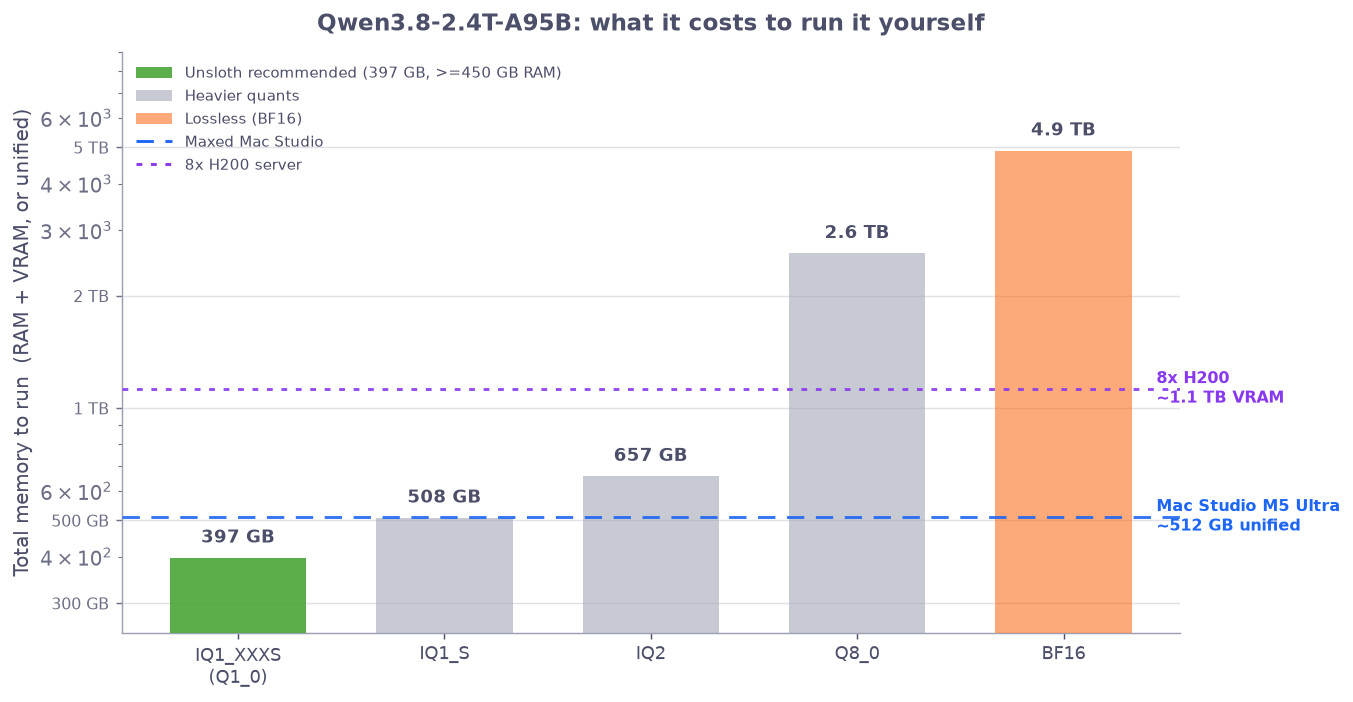
If your machine has roughly the memory of the quant you pick, and you are willing to trade some quality for a lot of size. Unsloth’s recommendation is to use the dynamic 1-bit XXXS quant, which compresses the model 91 percent and lands at 397GB on disk (Unsloth 2026a). They call it Q1_0 in the GGUF repo for naming reasons. You need at least 450GB of total memory to run it comfortably.
The full picture across quants looks like this. Total memory means RAM plus VRAM, or unified memory on something like a Mac Studio:
| Quantization | Disk / memory footprint |
|---|---|
Dynamic 1-bit XXXS (IQ1_XXXS / Q1_0) |
397 GB |
Dynamic 1-bit Standard (IQ1_S) |
508 GB |
Dynamic 2-bit (IQ2) |
657 GB |
Q8_0 (8-bit) |
2.6 TB |
BF16 (lossless) |
4.9 TB |
The rule of thumb Unsloth gives is that your total memory should be about the size of the quant, otherwise it still runs but it starts offloading to disk and gets much slower (Unsloth 2026a). So 397GB is the floor for the recommended quant, and 4.9TB is what lossless costs you.
Let me ground those numbers in real hardware. A maxed-out Mac Studio M5 Ultra tops out around 512GB of unified memory. That machine can run the 397GB IQ1_XXXS quant with headroom, and probably the 508GB IQ1_S if you squint. It cannot run Q8_0 or BF16. On the GPU side, eight H200s (141GB of HBM3e each) give you about 1.1TB of VRAM, which clears the 657GB 2-bit quant comfortably and gets you thinking about Q8_0. Lossless BF16 at 4.9TB is a small-datacenter job, full stop.
This is the part that matters for the European argument. “Open weights” and “self-hostable on hardware you own” are different sentences at the frontier. The weights being open removes the licensing dependency and the API shutdown risk. It does not remove the compute dependency. To run the frontier open model at the quants that actually preserve its quality, you are still buying roughly eight H200s, which is still buying Nvidia, which is still a dependency on Santa Clara that European policy has also refused to address. Open weights shift which pillar you depend on. They don’t remove the pillar.
How to actually run it
If you have the iron and you want to try it, here is the Unsloth-recommended path (Unsloth 2026a). The new 1-bit quantization types need a patched llama.cpp branch, so build from the iq1-narrow branch rather than main:
apt-get update
apt-get install pciutils build-essential cmake curl libcurl4-openssl-dev -y
git clone --branch iq1-narrow https://github.com/unslothai/llama.cpp
cmake llama.cpp -B llama.cpp/build -DBUILD_SHARED_LIBS=OFF -DGGML_CUDA=ON
cmake --build llama.cpp/build --config Release -j --clean-first \
    --target llama-cli llama-mtmd-cli llama-server llama-gguf-split
cp llama.cpp/build/bin/llama-* llama.cpp
Drop -DGGML_CUDA=ON to OFF if you are running on CPU only or on Apple Silicon (Metal is on by default).
Then pull the recommended 397GB quant:
pip install -U "huggingface_hub[cli]"
hf download unsloth/Qwen3.8-2.4T-A95B-GGUF \
    --local-dir unsloth/Qwen3.8-2.4T-A95B-GGUF \
    --include "*Q1_0*"
And run it:
./llama.cpp/llama-cli \
    --model unsloth/Qwen3.8-2.4T-A95B-GGUF/UD-Q1_0/Qwen3.8-2.4T-A95B-UD-Q1_0-00001-of-00010.gguf \
    --temp 1.0 --top-p 0.95 --top-k 20 --min-p 0.0 \
    --presence-penalty 0.0 --repetition-penalty 1.0
The inference settings matter because the open Qwen3.8 models are thinking-only: temperature 1.0, top-p 0.95, top-k 20, min-p 0.0. Context goes up to about 1.01 million tokens. On a B200 box you should see around 20 tokens per second of generation and over 120 tokens per second of throughput, which is genuinely usable for a single-user setup. If your memory is smaller than the quant, it still runs, it just pages to disk and you watch the tokens crawl.
If you’d rather skip the command line, Unsloth Desktop wraps the same thing in a UI: search for Qwen3.8 in the model hub, pick your quant, and it auto-detects multi-GPU setups and handles RAM offloading. Same weights, same llama.cpp under the hood.
What this means for Europe
The grace period I described was the window where open weights bought Europe time to build its own frontier lab, at the cost of depending on Chinese releases we don’t control (Green 2026b). The implicit assumption was that the open tier would stay a step behind the closed tier, a 27B here and a 405B there, while the real frontier stayed rentable from San Francisco or Hangzhou by the token.
That assumption is gone. The open tier is the frontier. A 2.4 trillion parameter MoE, 95B active, thinking-only, a handful of composite points off the best closed model on the Artificial Analysis index (Artificial Analysis 2026), is sitting on Hugging Face right now with a permissive license and a llama.cpp inference path. The capability gap between “what you can rent from Anthropic” and “what you can download and run yourself” is now measured in single digits, on a composite that tries to be fair. The marketing-tier framing was wrong because the frontier itself shipped open. There’s no smaller tier below it kept around for developer mindshare.
The grace period is still real, and it’s still revocable. Two things changed about it.
- The capability part got better than I expected: The open frontier arrived, weeks ahead of my forecast.
- The sovereignty part got worse than I expected: the open frontier arrived from Hangzhou, built on Chinese compute, under a national-strategy signal set in Beijing (The Next Web 2026), and the only European contribution to the stack is the Nvidia GPUs we buy to run it. We swapped one foreign invoice for another. The pillar moved from closed-API-Chinese to open-weights-Chinese. It did not move closer to European.
This was a choice Alibaba made, in a week, because the policy wind changed. The same policy wind can change back. Weights already downloaded are unenforceable to recall, and the model in my download queue stays mine. Future releases are not. A frontier that arrives as a policy favor serves the nation that granted the favor, and serves the rest of us only as long as serving us suits it.
The European read is unchanged from the Two Pillars post and I’ll keep saying it until it’s boring (Green 2026c). The living version of this argument, with the scores and the access regimes updated each time a frontier model lands, lives in the scoreboard (Green 2026a). We know how to spend at frontier-lab scale: CERN and ESA together spend about €9.9 billion a year, roughly what Anthropic spent in 2025 (Epoch AI 2026). We have the legal machinery for strategic preference: SAFE, the International Procurement Instrument, the defense carve-outs. We apply it to particles and rockets and artillery. We do not apply it to the thing eating the rest of the economy.
The open tier being the frontier is the best news Europe has had on AI in a year. It buys us time and it removes the API-shutdown risk from the dependency stack. It does not build us a pillar. The clock still belongs to someone else, and the clock still runs.
Conclusion
Since Kimi-K3 (Moonshot AI 2026) and Qwen 3.8 (Alibaba / Qwen Team 2026) the open-weights frontier is here, you can run it on a maxed Mac Studio if you accept the 1-bit quant, and Europe still has no domestic frontier lab to contribute to it. Why are we still paying them to do it in San Francisco and Hangzhou instead of here?